Plantar Fasciitis: How to Get Rid of Stabbing Heel Pain!
Stabbing heel pain with your first steps in the morning? Chances are it's plantar fasciitis. Find out what it is, what you can do about it, and which exercises really help.
You swing your legs out of bed, take your first steps towards the bathroom and… ouch. A sharp, stabbing pain under your heel, as if you'd stepped on a nail. It eases after a few minutes, but after a day on your feet the pain is back in full force by evening. Sound familiar? Then you most likely have plantar fasciitis: the most common cause of heel pain. Annoying and stubborn — but the good news is that in the vast majority of cases you can get rid of it without surgery or injections. In this article you'll learn exactly what plantar fasciitis is, what causes it and — most importantly — what you can start doing about it today. Including three exercises that are proven to work.
What is plantar fasciitis?
A strong band of connective tissue runs along the bottom of your foot from your heel to your toes: the plantar fascia. This band supports your arch and absorbs a serious load with every step — up to several times your body weight when running. With plantar fasciitis, the attachment of this fascia to your heel bone becomes overloaded and irritated. Tiny tears develop in the tissue faster than your body can repair them, and the attachment becomes painful.
The name is actually a little misleading: although "itis" suggests inflammation, it's usually not a classic inflammation but overload with micro-damage. That's why rest alone often doesn't fix it — the fascia needs to be gradually made stronger. Plantar fasciitis is very common: an estimated one in ten people will experience it at some point, most often between the ages of 40 and 60, and strikingly often runners, people who work on their feet, and people with flat feet or high arches.
Plantar fasciitis is often mentioned in the same breath as a heel spur: a calcium growth on the heel bone that can show up on X-rays. In short: the spur itself usually doesn't hurt — the irritated plantar fascia does. You can read more in our article about heel spurs.
Causes of plantar fasciitis
Plantar fasciitis is a classic overuse injury: the load has been greater than what the fascia can handle for (too) long. The most common causes and risk factors:
- Prolonged standing and walking: jobs that keep you on your feet all day, especially on hard floors, load the fascia continuously.
- Ramping up sport too quickly: suddenly running or walking (much) more or more often than you're used to is the classic trigger.
- Foot posture: both fallen arches (flat feet) and a high arch distribute pressure unevenly, putting extra traction on the attachment at the heel.
- Tight calves and Achilles tendon: stiff calves pull directly on the plantar fascia via the Achilles tendon and heel.
- Shoes without cushioning or support: flat, worn-out shoes, flip-flops or suddenly walking barefoot leave the fascia unsupported.
- Being overweight: every extra kilo lands directly on the plantar fascia with every step.
- Age: over the years the fat pad under the heel gets thinner and tendon tissue less elastic.
Symptoms: how to recognise it
The complaints of plantar fasciitis usually follow a typical pattern:
- First-step pain: sharp, stabbing pain under the heel with your first steps in the morning or after sitting for a while, easing after a few minutes of walking.
- Pain after activity: after a long day of standing or a big walk, the pain returns in full force in the evening.
- Tenderness at one specific spot: the inside of the heel, where the fascia attaches.
- A pulling or burning pain that sometimes runs along the arch towards the toes.
- A stiff feeling under the foot, especially when pulling up your toes.
Is the pain not under your heel but under the ball of your foot? Then it's more likely a forefoot problem such as metatarsalgia. And if your whole sole burns or tingles, even at rest, something else may be going on — that's worth a visit to your doctor.

Bracefox® Heel Spur Insoles – ErgoSole
Medical insoles that offload the plantar fascia and cushion the heel.
ViewWhat can you do yourself?
Treating plantar fasciitis rests on two pillars: offloading the fascia where needed, and making it stronger with exercises. With this combination, the vast majority of people recover within a few months:
- Wear supportive insoles: insoles with good arch support and heel cushioning take traction off the fascia straight away — you'll often feel the difference within days. Wear them in all the shoes you use a lot.
- Manage the load: you don't have to stop moving, but cut out the peaks. Alternate long periods of standing and walking with sitting, and spread walks across the day.
- Choose good shoes: a firm sole, slight heel (no flat flip-flops), decent cushioning. Don't walk your first morning steps barefoot.
- Stretch your calves daily: supple calves reduce the pull on the heel and fascia (see the exercises below).
- Cool sharp pain: roll your sole over a frozen bottle of water for 10 minutes — cooling and massage in one.
- Work towards a healthy weight: fewer kilos means less traction on the attachment with every step.
- Be patient: tendon tissue heals slowly. Think weeks to months — and don't let the first pain-free days tempt you into full loading again.
3 exercises for plantar fasciitis
These three exercises are the core of recovery: they make the fascia and calves more supple and gradually stronger. Do them daily; mild discomfort is fine, sharp pain means take a step back.
Exercise 1: plantar fascia stretch (before getting up)
- Sit down and cross the leg of your painful foot over your other knee.
- Grab your toes and gently pull them towards your shin until you feel a stretch under your sole.
- Hold for 30 seconds and repeat 3 times.
- Do this especially in the morning before your first steps and after sitting for long — it takes the edge off the first-step pain.
Exercise 2: calf stretch against the wall
- Place your hands against the wall and step your painful leg well back, heel flat on the floor.
- Bend your front knee until you feel a stretch in the calf of your back leg. Keep the back knee straight.
- Hold for 30 seconds, repeat 3 times, then do the same with the back knee slightly bent for the deep calf muscle.
- Do this twice a day.
Exercise 3: heel raises on a step (strength)
- Stand with the balls of your feet on a step, heels free, holding the railing.
- Push yourself up onto your toes in 2 counts, then lower very slowly (3 counts) until your heels drop just below the step.
- Do 3 sets of 10 to 12 repetitions, every other day.
- This exercise measurably strengthens the plantar fascia and Achilles tendon — the difference between temporary and lasting recovery.
When to see a doctor?
You can treat plantar fasciitis yourself in most cases. Do make an appointment with your doctor if:
- the pain doesn't clearly improve after six to eight weeks of self-care and exercises;
- your heel is swollen, warm or red, or you have a fever;
- the pain started suddenly during a jump or fall (something may be torn or broken);
- you have tingling or numbness in your foot — that points more towards a nerve problem;
- you have diabetes and develop foot complaints.
Your doctor can refer you to a physiotherapist or podiatrist for guidance. Injections or surgery are rarely needed for plantar fasciitis; exercise therapy plus good support is and remains the first choice.
Our recommendations for plantar fasciitis
Support under your foot isn't a luxury with plantar fasciitis — it's a core part of the treatment. The Bracefox® Heel Spur Insoles – ErgoSole were designed for exactly this: they support the arch so traction on the fascia decreases, and cushion the heel right where it hurts. Ideal for your everyday and work shoes, so the fascia is offloaded all day long while you simply carry on.
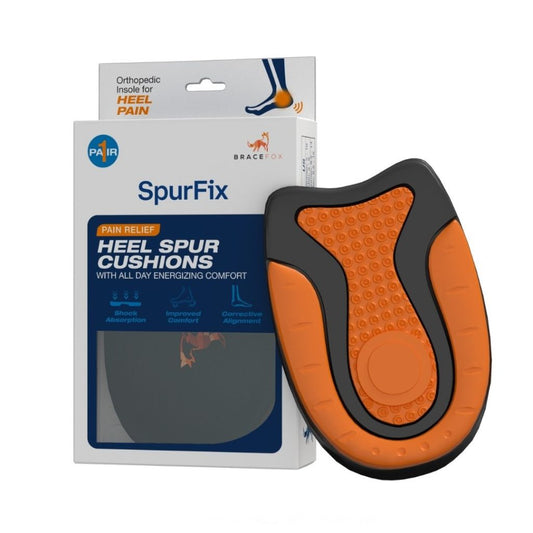
Looking for fast relief directly at the heel, or a slim solution for narrower shoes? The Bracefox® Gel Heel Cushions – SpurFix absorb every step with their soft gel core and reduce pressure on the painful attachment — a great addition for days with lots of standing or walking.

Bracefox® Gel Heel Cushions – SpurFix
Instant cushioning and pressure relief under the painful heel.
ViewFrequently asked questions about plantar fasciitis
How long does plantar fasciitis last?
With a consistent approach (support, load management and daily exercises) most people notice clear improvement within six to twelve weeks. Full recovery can take several months, sometimes up to a year. The sooner you start with the right approach, the shorter the journey.
What's the difference between plantar fasciitis and a heel spur?
Plantar fasciitis is the overloaded, painful attachment of the plantar fascia. A heel spur is a calcium growth on the heel bone that can develop after years of traction. Many people with heel pain have both, but the pain almost always comes from the irritated fascia — not the spur itself. The treatment is therefore the same.
Can I keep walking or exercising with plantar fasciitis?
Yes, moving is allowed and even good — but manage the dose. Temporarily avoid long distances and hard surfaces, and switch to cycling or swimming as alternatives. Complete rest only makes the fascia weaker; the exercises in this article make it more resilient.
Do insoles really help with plantar fasciitis?
Yes. Insoles with arch support and heel cushioning reduce the traction on the fascia with every step, easing the pain and giving the tissue a chance to heal. They work best combined with the stretching and strengthening exercises — support plus getting stronger.
Why does my heel hurt most in the morning?
While you sleep, your foot rests in a relaxed, pointed position, keeping the plantar fascia shortened for hours. With your first steps it's suddenly stretched to full length — that's the typical sharp first-step pain. The fascia stretch before getting up makes that moment much milder.
Can plantar fasciitis come back?
Yes — especially if the original cause (ramping up too fast, a standing job, lack of support) stays unchanged. So keep your calves supple after recovery, build up sport gradually and keep wearing supportive insoles on days when you're on your feet a lot.